1. About 50 percent of the native Indian population lives on reservations. The majority of the reservations are situated west of the Mississippi River.
2. Unemployment, poverty, alcoholism, drug abuse, high rates of diabetes and heart disease are a concern. Because of all the prejudices they get unemployed, and this leads to poverty and so on, alcoholism and then the rest of the remaining.
3. Limitations on tribal powers of self-government include the same limitations applicable to states; for example, neither tribes nor states have the power to make war, engage in foreign relations, or coin money.
4.
mandag 11. mai 2015

onsdag 22. april 2015
Stolen Generation
Checkpoints:
2. The Aborigines was halved because of diseases, smallpox was one of them. The whites wanted the best areas to cultivate and start their lives, so the moved the native population to other places.
3. It is estimated that more than 100, 000 children were taken away from their parents.
Research and Discover(One):
1. The Māori originated with settlers from eastern Polynesia, who arrived in New Zealand in several waves of canoe voyages at some time between 1250 and 1300. To many Maori people today, the most significant issue in New Zealand remains that of land.
2.
Aborigines:
Since the European invasion of Australia in 1788, the Aboriginal people have been oppressed into a world unnatural to their existence for thousands of years. First came the influx of the strangers who carried with them diseases, which decimated the immediate population of the Sydney tribes. It is estimated that over 750,000 Aboriginal people inhabited the island continent in 1788. The colonists were led to believe that the land was terra nullius, which Lt James Cook declared Australia to be in 1770 during his voyage around the coast of Australia.
Maori:
The ancestors of the Māori were a Polynesian people originating from south-east Asia. Some historians trace the early Polynesian settlers of New Zealand as migrating from today's China, making the long voyage traveling via Taiwan, through the South Pacific and on to Aotearoa (New Zealand).
The anthropologist Thor Heyerdahl, on the other hand, claims that the Polynesians arrived in the Pacific from America, rather than from the East, as other scholars claim. Heyerdahl bases his theory on the fact that the kumara, staple cultivated food crop of the pre-European New Zealand Māori, originates from central South America. Around thirty thousand years ago, Polynesian forbears inhabited the Bismarck Archipelago, to the east of New Guinea. These people had a Lapita culture, of which earthenware pots, distinctive and highly colored, were a characteristic. This particular pottery was given the name of Lapita Ware, after an archaeological site in New Caledonia.
3. Because they have been to different islands and cam in different decades, so they have been built up in different ways. Then the experiences follow up to be different when they live on different islands and have different cultures.
mandag 23. mars 2015
Imaginary Friend
My imaginary friend, Bobby Franklin, lives in the White House, Pennsylvania Avenue in Washington D.C. Bobby is born in Lomé in Togo. Mr. Franklin is a Buddhist, but this Monday, March 23rd he wants to convert to Muslim. The reason of his convert is his time during the Cold War. Here is a pic of Bobby:

Words That Are Easily Confused
Then and Than:


Witch and which:
 Witch - which

Threw and through:

There, their and they're:

To, too and two:

Lose and loose:
 Lose - loose

mandag 16. mars 2015
A Passage to India
Creative stunts!

She is the prime minister of India, her profession is politics, she loves politics. She is speaking to Obama about the Indian economy, she needs Obama's help. She is going to the White House. She is thinking of all the economical help she can get from The United States.
Checkpoint.
1. Independence
2. Government
3. Economy
4. Caste
5. Remove Caste System?
6. Education
7. Wealth
mandag 9. mars 2015
The Imitation Game
Alan Turing was a man with many qualities, but he as any others had his weaknesses. He was a smart fella with outstanding math knowledge. But his weakness was to know how to act when he was with other people and how to act socially. Love was not his strongest side either. He also was a homosexual, but pretended to be straight.
His mathematical skills was amazing, he was the one solving The Enigma code. In the start his team was not happy with him on the team, because he was acting weird among people and preferred to work alone.

His mathematical skills was amazing, he was the one solving The Enigma code. In the start his team was not happy with him on the team, because he was acting weird among people and preferred to work alone.
søndag 11. januar 2015
Events in American History
1. Because many of the colonists felt like they were Americans. It started to be conflicts around these colonies, so for avoiding problems it was a good reason.
2. Today the infrastructure is so good so we don't need to colonize other countries. Now days we can talk with each other very easily. Back in time it was harder to travel across countries and talk to each other so colonies back in the time was very good to have. Today it isn't necessarily to have colonies in my opinion.
3. The Americans feel this is important for safety, but i think it's very dumb. Because of this it is massacres and much crime. It is only the feeling of being safe you get. How many people would fire shots with the gun they got?
4. List of historical events: The Viking Period: was from between 800-1100 AD, At the start of the Viking Period, Norway was not one united country, but many small kingdoms. Harald Fairhair (Harald Hårfagre) became king of a large portion of Norway in 872. The union between Denmark and Norway: During the 1300s Denmark gained more and more influence over Norway and, in 1397, Norway was absorbed into a formal union with Denmark and Sweden. The union was ruled by a common king. Sweden gradually seceded from the union, but Denmark and Norway remained united until 1814. The union was governed from Denmark. Copenhagen was the cultural centre of the union and Norwegians read and wrote in Danish.The plague: The black death came to Norway in 1349, in short time it had killed a third of the norwegian population. The Norweigan constitution: The Norwegian constitution was formed in 1814, and thus we broke free of the danish grasp. WW2: The natzi's invaded us in 9th of April 1940, and by that, Norway was drawn into the war.
fredag 12. desember 2014
The American Dream
Large-scale Mexican migration to the United States began in the early 20th century, motivated by labor demands in the United States and political unrest in Mexico. Throughout the 20th century, major reforms to the U.S. immigration system played a role in shaping the size and character of Mexican immigration flows. Since 1980, Mexicans have been the largest immigrant group in the United States. As of 2013, approximately 11.6 million Mexican immigrants resided in the United States—up from 2.2 million in 1980—and Mexicans accounted for 28 percent of the country’s 41.3 million foreign born.
Immigration from Mexico to the United States has gone through four main periods. The first wave, occurring prior to World War II, consisted of agricultural workers recruited by private labor contractors, with the number of Mexican immigrants rising from 105,200 in 1900 to 624,400 in 1930. The Bracero program, from 1942 to 1964, ushered in the second wave, also consisting mostly of agricultural guest workers. The third, largely unauthorized wave began after the Bracero program was terminated and after 1965 changes to U.S. immigration law ended national-origin quotas and imposed the first numerical limits on Mexico and other Latin American countries. The majority of Mexican immigrants in this third wave were male, seasonal farm laborers who regularly traveled back and forth across the border. The passage of the Immigration Reform and Control Act of 1986 (IRCA) and subsequent investments in border security were a turning point, initiating the fourth wave of Mexican migration. IRCA legalized close to 3 million unauthorized migrants, including 2.3 million Mexicans, in return for tougher border enforcement and penalties for American employers who hired unauthorized workers. As crossing the border became more difficult, and as economic changes in the United States opened additional jobs to low-skilled foreign workers, immigrants began to settle permanently, bringing their families to live in the United States. Between 1990 and 2010 more than 7.5 million Mexican immigrants—many of whom were unauthorized—arrived.
More recently, Mexican immigration to the United States has begun to decline—marking at least a pause, and possibly an end to the fourth wave. Declining inflows appear to reflect the impact of the Great Recession, improved educational and economic opportunities in Mexico, and ever-tougher border enforcement.
mandag 1. desember 2014
mandag 27. oktober 2014
Road Trip!!
Hello everyone! Today I have to tell you about our amazing roadtrip in the UK! :)
On this road trip we drove a 2014 Chevrolet Camaro ss ZL1 with a turbo charged 580hp engine. In my opinion the car is fantastic. It does 0-60 in only 3,9 seconds. The interior is also very nice and the comfort is astonishing.
Here is a picture of the car.
On this road trip we drove a 2014 Chevrolet Camaro ss ZL1 with a turbo charged 580hp engine. In my opinion the car is fantastic. It does 0-60 in only 3,9 seconds. The interior is also very nice and the comfort is astonishing.
Here is a picture of the car.


After this meal, we went to Oxford to look at the nice streets, and we ate some Belgian waffles for dessert. Then we had to go to an intense football match! Arsenal - Real Madrid! The match was played at Emirates a BEAUTIFUL stadium.


The route for this day.
Day 2:We left London early in the morning. We were heading for Nottingham and then the plan was to stay there for some hours and then go to Liverpool where we would stay for two days. We drove for approximately three and a half hours to Nottingham. Nottingham is in the middle of England and not a too great of a detour. On the way out of London the traffic was heavy and there was a terrible queue. We realized that it was not really a smart move to book a hotel in the middle of a city with over eight million inhabitants who drive on the left side of the road. We were close to many accidents on our way, but fortunately we came out of the city alive.We drove on the highway to Nottingham, with only some small stops to fill fuel and we ate once in in a café by the road. The food was terrible. We got some wet sandwiches with ham, cheese and some kind of very bad tasting omelette. When we finally arrived in Nottingham, we went to the Robin Hood museum. Vegard is a very big Robin Hood fan, so he loved the museum very much. We ended up spending so much time in the museum that we had to use much less time in the rest of Nottingham and go straight to Liverpool.We arrived in Liverpool right before midnight and checked in to the hotel. We were very tired after the long ride but we convinced ourselves that is was the best if we could get something to eat. Per fell asleep just before we left so we had to wake him, but he refused to get out of the bed. I went with Vegard down to a kebab restaurant some blocks away.
 |
| John Lennons house. |
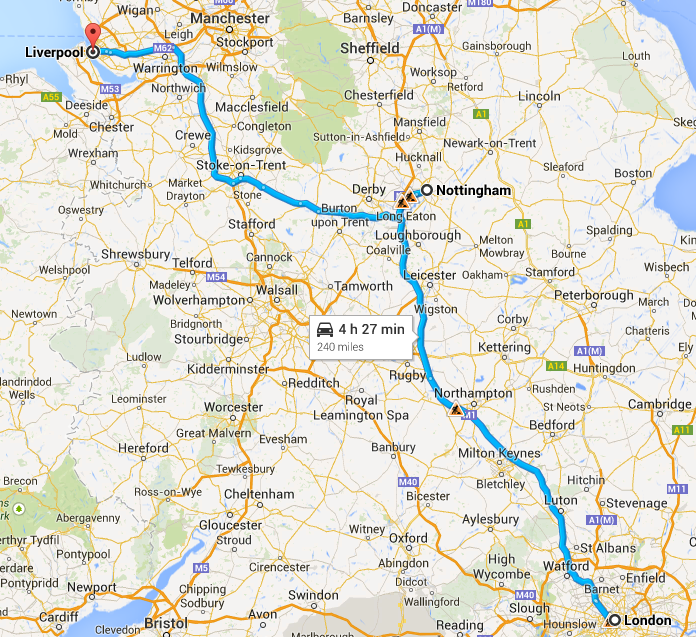 |
| The route for this day. |
Day 3:We woke around eleven and missed the breakfast with only some minutes. We were looking forward to the football match that would happen later that night. We ate at some café and watched the local life. The streets were mostly empty but that was probably because it was in the middle of the week. When we had finished eating, we went to John Lennon’s home. It was cool to look at the place he grew up. The place crawled with tourists. After we finished, we went to some other café to have lunch. The food there was perfect. Eggs and bacon with a lot of other garniture. Then we went back to the hotel and got ready for the match.The match began at half past eight. We came one hour before the match started, and we had booked premium tickets. The view from our seats was amazing. The match was Liverpool versus Barcelona. In the end, the score was 3-1 to Liverpool. When the match ended, we went back to the hotel because we had a long trip ahead of us the next day.
Day 4:After 5 hours and 335 km on the road. We finally arrived to our final destination, Edinburgh, Scotland. We had big plans for this day. Edinburgh was a hectic city with much traffic and noise. We had to drive around the city in our yellow Camaro for a while to find our hotel, we had chosen Waldorf Astoria Edinburgh - The Caledonian to be the best hotel in the city and this was the place, we would stay for the night. When we had parked our car, we walked to the hotel reception to check in. We had paid 4500 Norwegian kroners to get the best and biggest room. We were going to sleep well the last night of our trip.After we had checked in, we went out to eat a burger on Mc Donald’s. We had planned that we should go and play some “bubble soccer”, this is a game of football, with a giant ball around your body, and you can bump as hard as you want into others without causing any damage on the other players. Sverre scored five goals in the match. We played football for 3 hours.

 |
| The Royal Military tattoo. |

Day 5:
This was our last day in UK, our flight were supposed to leave Edinburgh at 13.00. We had a lot to do before we went to the airport. First, we ate a fantastic breakfast at our hotel; it contained a lot of bacon, eggs and sausages. After the breakfast we carried our luggage to our yellow Camaro, before we drove to the place we had to give the car back to the rent company, we rented the car from. We found Avis after a while and delivered the car. At 11.00 we took a taxi to the airport. After an hour of waiting, we were told to board the plane. This was the end of the trip. It has been a lot of fun and we recommend everyone to do it.

Leave a comment if you enjoyed it!!
mandag 20. oktober 2014
Letter To Nazneen (Brick Lane)
Dear Nazneen!
Dear Nazneen how are you? I hope you are good, and that you have gotten a good life with your husband. As you warned me of father has thrown me out of the family because I chose Malek instead of an arranged marriage like you. However, I do wonder how you could just let father do that to you,you don`t even know the man, and he is so much older than you are! I havefound true love, and I am standing with him until the end!
Sincerely your sister!
Dear Nazneen how are you? I hope you are good, and that you have gotten a good life with your husband. As you warned me of father has thrown me out of the family because I chose Malek instead of an arranged marriage like you. However, I do wonder how you could just let father do that to you,you don`t even know the man, and he is so much older than you are! I havefound true love, and I am standing with him until the end!
I’m living a carefree life here in Bangladesh. I’m traveling around from one adventure to the next. It’s so much fun! I feel like I have the time of my life right now, the only thing missing is you...
I´m sorry for not writing you earlier, but things have been a little hectic lately, as you probably understand, and the opportunity had yet to arise until this evening.
I hope we can keep in touch, but don’t tell our parents where I live, because they will kill me for what I did. I really love you and I miss your hugs. I hope to see you soon.
tirsdag 7. oktober 2014
Events that Shaped English
The angelo-saxons
When?:
Before the 9th.
century
Why?:
Scandinavian
invaders came to the British isles in the middle of the 9th century.
How?:
You can trace them
in words like you, is the and that.
1066 and after
When?:
The battle of Hastings in 1066
Why?:
William the Conqueror defeated Harold Godwinson. Old English
broke down and Middle English became quite similar.
How?:
About 10 000 loanwords from the French ruling class
and elite.
Scandinavian Settlement
When?:
Scandinavian invader came to Britain in the middle of the 9th century.
Why?:
They invaded Britain and Norse had a great influence on
English.
How?:
Both Norse and English were very similar, because they were
both Germanic languages. Basic words such as “take” and “they” are borrowed
from Norse.
Standardization
When?:
The late medieval and early modern periods.
Why?:
London English became associated with knowledge and spelling
became standardized. In addition, the pronunciation occurred.
How?:
The Middle English changed so that the Modern English became
reality.
Colonization and
Globalization
When?:
When the colonization started and the globalization is ongoing
right now.
Why?:
All the colonies spread all over the world made English a
global language.
How?:
English is today a world-spoken language. Probably the most
widely spoken and it’s a very important language as either first or secondary
language.

onsdag 24. september 2014
Global English Summed Up In 5 Sentences

It started because of the colonies and the Britain sailors that sailed around in the world. It has grown because of the colonies and because of people in the world found out it was an easier way to communicate, because of this it also has started to be 2nd learnt language in many countries. Many of the words has been created by old historical people(like Shakespeare) and poets. The English language is not the same all over the world, because of the different countries have different accents and some of the countries have different words for the same things, even USA and Great Britain have different words. It's more people in South Asia that can speak English than in USA and Britain together.
History of Global English in 10 Minutes
How English Became a Global Language
onsdag 10. september 2014
Schoolyard Poem!
I just walked a round in the schoolyard and observed the terrain, and then I had an epiphany! I wanted to make a poem about the schoolyard and what i saw.
I was walking down a gravelled road
When I saw a big ugly toad.
My teachers Smart was at the parking lot
And there was some people smoking pot.
I heard a big excavator
They were building an elevator.
 |
| The excavator! |
This was my poem hope you enjoyed it!
onsdag 3. september 2014
"If you have never been hated by your child you have never been a parent"
I'm going to tell what i think of this quote and what I mean is true with it.
In my opinion this quote is quite true! When you are a parent you have a response ability to take care of that kid and raise him. You have to be a bit strict to raise your child right, you can't just spoil the child and let it do what it want. Of course you have to be nice, but if you haven't been really strict to your child once you aren't a real parent in my opinion, or else you have a too nice kid.
This is only my opinion, this isn't what is right or wrong, there is no right or wrong.
What Is Your Opinion of This Quote??
Answer in the comments!
mandag 1. september 2014
Casual Class Trip
Last week I went on a trip with my class. This trip was a large bit of the geography curriculum. Our first important stop were in Helvete ("Hell"). In Helvete we watched potholes, this was kind of weird and special, but exciting. We had to walk up a waterfall, they had built a stair in the middle of a waterfall... This pothole was really special and interesting.
Our next stop was something weird, it's name was Kvitskriuprestinn, it was some white columns of moraine in the middle of the nature, omg omg omg. This was created by the last Ice Age. This is a nature phenomenon, it is really special!!!!

This is what it looked like, I just gasped and was shocked about these columns.
This is my Friend Svøre:
Our next stop was something weird, it's name was Kvitskriuprestinn, it was some white columns of moraine in the middle of the nature, omg omg omg. This was created by the last Ice Age. This is a nature phenomenon, it is really special!!!!
This is what it looked like, I just gasped and was shocked about these columns.
This is my Friend Svøre:
 |
| This is Svøre :) Check out his blog! http://pollockblo.blogspot.no/ |
The next day we wore at a museum, here we learnt about for example hunting in the past and about a glacier. After the museum we walked inside a glacier. It was weird to walk inside a glacier. It was designed inside and we watched a movie about how it was built!!
The last thing on the list was to climb up Galdhøpiggen, Norways highest mountain, unfortunately i couldn't join the class because of a knee injury... So i had to sit in a cabin for 6 hours or something, it was boring...
So guys that was my class trip, pls comment and say what you think about my blog or my trip!
mandag 25. august 2014
Comparing 3 lyrics

No Man is an Island by John Donne
No man is an island,
Entire of itself,
Every man is a piece of the continent,
A part of the main.
Any man's death diminishes me,
Because I am involved in mankind,
And therefore never send to know for whom the bell tolls;
It tolls for thee.
2nd text:
I am a Rock by Paul Simon
A winter's day
In a deep and dark December;
I am alone,
Gazing from my window to the streets below
On a freshly fallen silent shroud of snow.
I am a rock,
I am an island.
I've built walls,
A fortress deep and mighty,
That none may penetrate.
I have no need of friendship; friendship causes pain.
It's laughter and it's loving I disdain.
I am a rock,
I am an island.
Don't talk of love,
But I've heard the words before;
It's sleeping in my memory.
I won't disturb the slumber of feelings that have died.
If I never loved I never would have cried.
I am a rock,
I am an island.
I have my books
And my poetry to protect me;
I am shielded in my armor,
Hiding in my room, safe within my womb.
I touch no one and no one touches me.
I am a rock,
I am an island.
And a rock feels no pain;
And an island never cries.
3rd text:
You'll Never Walk Alone by Rogers and Hammerstein
When you walk through a storm, hold your head up high
And don’t be afraid of the dark
At the end of the storm, there’s a golden sky
And the sweet, silver song of a lark
And don’t be afraid of the dark
At the end of the storm, there’s a golden sky
And the sweet, silver song of a lark
Walk on through the wind
Walk on through the rain
Though your dreams be tossed and blown
Walk on through the rain
Though your dreams be tossed and blown
Walk on, walk on
With hope in your heart
And you’ll never walk alone
You’ll never walk alone
With hope in your heart
And you’ll never walk alone
You’ll never walk alone
Walk on, walk on
With hope in your heart
And you’ll never walk alone
You’ll never walk alone
With hope in your heart
And you’ll never walk alone
You’ll never walk alone
I am going to compare these three lyrics. I think that all of these refers to a friendship or a relationship. I'm going to tell how each of the lyrics refers to friendship or relationship.
No Man is an Island:
This text says that it's always somone there to support you. So even when you feel alone and your friend left you, there are always someone there for you.
I am a Rock:
This is the opposite of the two other lyrics, in this text you are alone. When you are at the bottom, I mean at the bottom, then you have to stay strong and lift you up. It says you are a rock and nothing can hurt a rock, and that you are an island and an island never cries.
You'll Never Walk Alone:
This says kind of the same as "No Man is an Island", you never alone, there will always be someone there to support you. It also says you have to lift your head high up. It also says that even though you've had a hard time you have somone to support you and you have to get up.


onsdag 20. august 2014
Abonner på:
Innlegg (Atom)